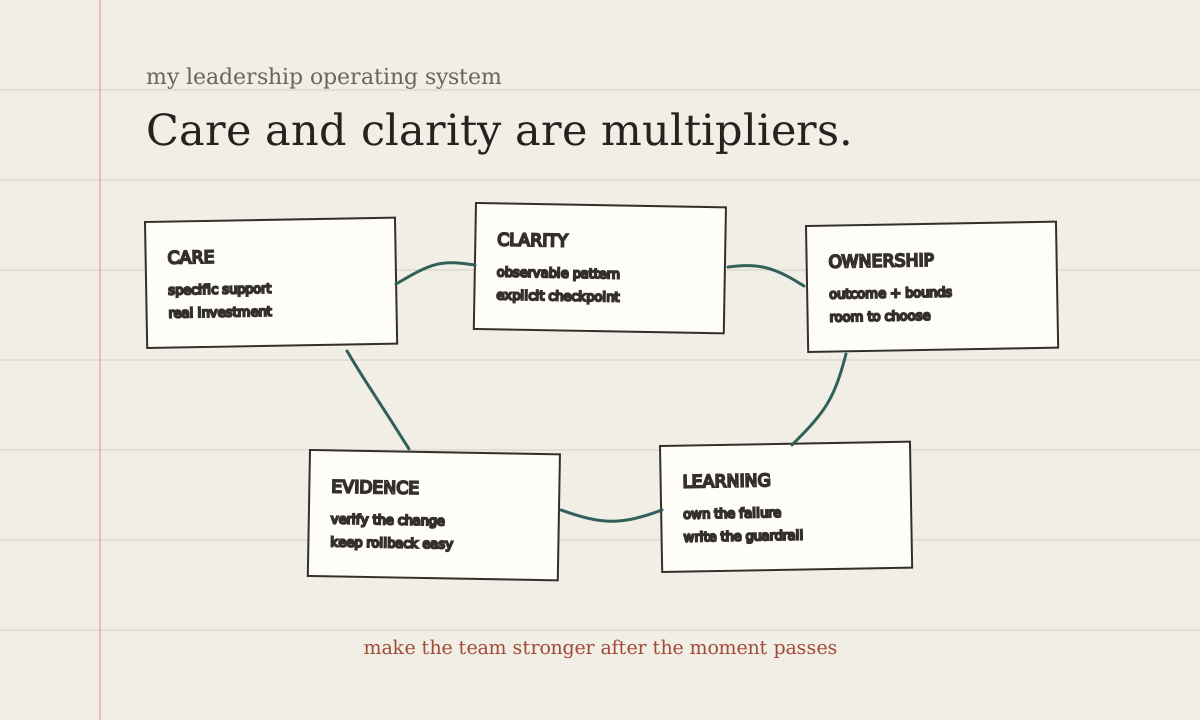
My leadership style is built around a simple tension: people deserve real care, and they also deserve clarity. I try to be supportive without making expectations vague, and direct without reducing a person to a single outcome.
These principles grew out of coaching engineers, running infrastructure teams, leading migrations, and owning changes that did not go as planned. The situations were different, but the useful patterns repeated.
High care and direct challenge belong together
Difficult feedback works best when it is specific enough to act on. I describe the observable pattern, explain its effect on the team or system, and agree on the next checkpoint. The conversation stays private and respectful, but the expectation stays clear.
Support follows the same rule. “Let me know if you need help” is too abstract. Useful support might be a smaller first scope, a design review, a written runbook, paired work on the risky step, or protected time to learn the missing skill.
Calibrate ownership instead of granting it all at once
I want engineers to own meaningful systems and decisions. Ownership becomes durable when its size matches a person’s current context. I use progressively larger assignments with visible safety nets: staging first, explicit rollback, a review at the boundary of the unfamiliar part, and a short retrospective afterward.
As confidence and evidence grow, I remove checkpoints. The destination is not permanent supervision. It is independent judgment.
Treat anxiety as a requirements problem
Career concerns often arrive as emotion before they arrive as a concrete request. I try to translate that uncertainty into requirements: What kind of work is missing? Which skill needs evidence? What decision or system could the person own next? What will we review, and when?
That turns reassurance into a plan. It also makes career development part of real delivery rather than an activity that competes with it.
Build systems after the conversation
When a person makes a mistake, the first step is a direct conversation about judgment and impact. The next step is to ask why the system allowed one mistake to travel so far.
The durable response might be a protected branch, a staged rollout, a stronger alert, an automated validation, a checklist, or a reversible deployment path. Accountability and system design reinforce each other: one helps the person learn; the other keeps the entire team from paying for the same lesson again.
Make bold decisions verifiable
Large technical changes are decisions about evidence. Before committing to a migration or architectural shift, I ask what would prove that it is correct, what would reveal a regression early, and how quickly we can undo it.
That often means building the comparison harness before moving traffic, calculating the cost of each option, running both paths in parallel, and changing one major variable at a time. Verification creates speed because it replaces debate and intuition with an observable gate.
Write the rule from your own failure
Some of my strongest operating principles came from changes I led that failed. I believe the leader responsible should write the postmortem plainly, restore the system quickly, and turn each cause into a practice the team can reuse.
The rules I return to are practical:
- Move forward in measured steps and keep the reverse path simple.
- Change one important variable at a time.
- Rehearse risky work under realistic load.
- Avoid major production changes when the team cannot observe the result together.
- Hand off monitoring explicitly when ownership changes.
Owning the failure in public makes those rules credible. Applying them consistently makes the lesson useful.
Own the outcome across boundaries
Customers and teammates experience an outcome, not an org chart. When a problem crosses teams, I try to define the shared finish line and volunteer to keep it moving until that line is reached. That can mean coordinating the fix, writing the backfill, validating the final state, or giving another team a tool they can operate themselves.
This is also how I think about management. My job is to create the conditions for good work: enough context to decide, enough safety to experiment, enough candor to correct course, and enough trust that the team can operate when I am not in the room.