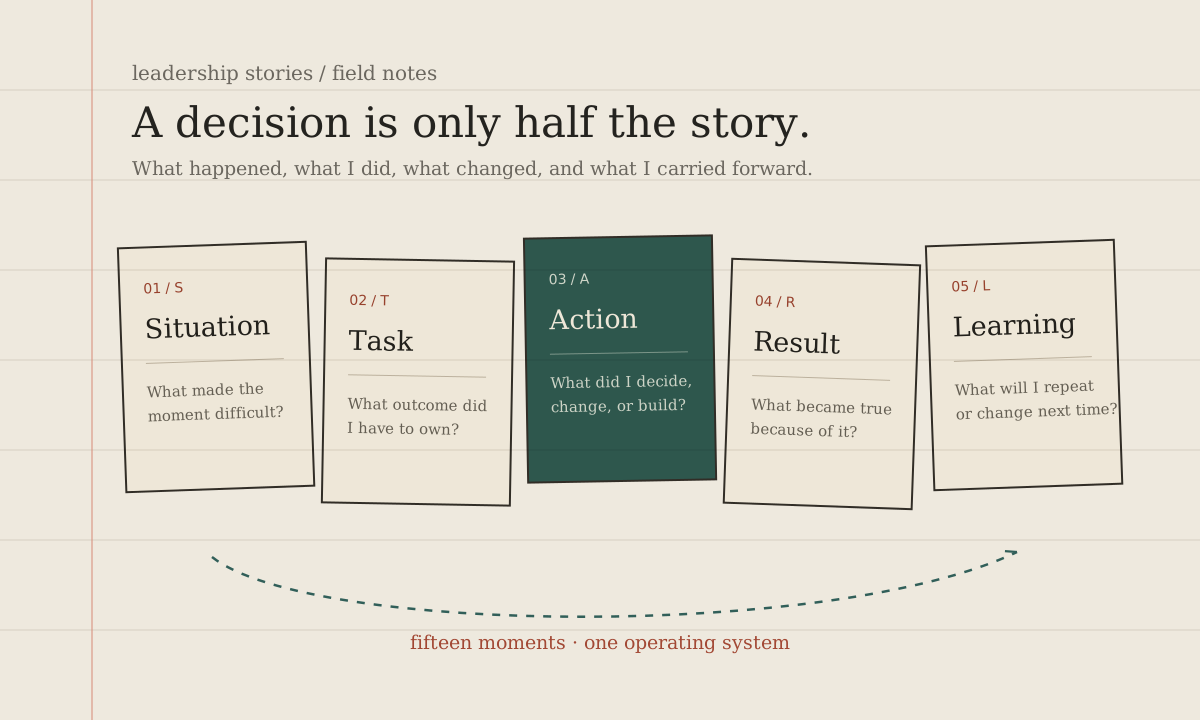
Leadership principles become useful when they survive contact with a difficult situation. This casebook collects examples from my work leading infrastructure and engineering teams, organized as Situation, Task, Action, Result, and Learning.
People, employers, customers, internal tools, system names, and sensitive figures have been anonymized. The technical setting is described only where it explains the decision. The focus is the leadership judgment, the action I took, and what I learned.
People leadership
1. Managing an underperformer with clarity and dignity
Situation. An engineer handled well-defined maintenance work reliably but struggled with incident diagnosis, cross-team communication, and the automation skills the role required.
Task. I needed to give the person a fair opportunity to close the gap while protecting on-call health and setting an honest standard for the role.
Action. I wrote a development plan around observable behaviors: collaborate earlier during incidents, ask clarifying questions before becoming stuck, study the systems behind recurring failures, and demonstrate automation through progressively larger assignments. We reviewed the plan weekly. I documented progress, gave direct written feedback, and involved my manager and the people team early as the trajectory became clear.
Result. The required gap did not close, so we completed a respectful separation without surprising the engineer or destabilizing the team. I then used the experience to recalibrate our interview process and the checkpoints in future development plans.
Learning. Kindness and clarity reinforce each other. Vague feedback delays the same difficult decision while denying the person a real chance to respond.
2. Growing an engineer through calibrated ownership
Situation. A junior engineer joined a team responsible for several unfamiliar production systems and initially needed close supervision.
Task. I wanted to help the engineer become an independent owner rather than a permanent recipient of instructions.
Action. I explained the architecture, paired on early tickets, and increased project size in deliberate steps. The engineer first handled supervised operational work, then wrote and rehearsed a complete deployment procedure in a test environment, then owned reliability improvements and disaster-recovery exercises. Each step had a visible safety net: written procedures, rehearsal, review at the unfamiliar boundary, and a retrospective.
Result. The engineer progressed to handling large on-call items, performing deeper root-cause analysis, communicating directly with partner teams, and delivering migrations with minimal supervision.
Learning. The growth lever was calibrated ownership. Each assignment was slightly larger than the last, while the safety net replaced hand-holding.
3. Turning a production conflict into a system improvement
Situation. Untested application code caused a production incident. The operations team absorbed the pager impact, creating friction with the development team responsible for the change.
Task. I needed to resolve the immediate issue and strengthen delivery controls without turning the review into a blame exercise.
Action. I spoke with the engineer privately first, then kept the incident review focused on the path that allowed untested code to reach production. I advocated for stronger staging rehearsal, dependency checks, and automated analysis at the delivery boundary. In the wider discussion, I framed the problem around the outcome and the missing guardrail rather than the person who triggered it.
Result. The response became a process improvement instead of a personal indictment. The engineer remained engaged, and the development and operations teams had a clearer shared standard for production readiness.
Learning. A conflict de-escalates when a person problem becomes a systems problem, but the direct private conversation still has to happen first.
4. Treating career anxiety as a requirements problem
Situation. An engineer told me that changes in the industry made their role feel uncertain and that their current work was not helping them grow.
Task. I needed to turn an abstract retention risk into work that built confidence, capability, and visible career evidence.
Action. I asked which skills and problems would make the role feel worthwhile, then used those answers to shape assignments. I routed intelligent-systems work toward the engineer and gave them ownership of a substantial data-platform migration that required both technical depth and cross-team coordination. We kept the goals from our one-on-ones as an explicit filter for future work.
Result. The engineer moved from anxiety about relevance to owning one of the team’s larger migrations and remained engaged with the team.
Learning. Reassurance is temporary. Treating the concern as a requirements document creates a plan that both the manager and engineer can act on.
5. Calibrating hiring decisions with evidence
Situation. I interviewed engineers for infrastructure roles and needed a consistent way to distinguish memorized knowledge from judgment in unfamiliar situations.
Task. Build a repeatable hiring process and improve it when interview signals failed to predict performance.
Action. I used a layered system-design scenario, operational fundamentals, a small coding exercise, and behavioral questions about teamwork and disagreement. For every candidate, I recorded the expected evidence and the answer actually given. After one hire struggled in ways that earlier interview notes had hinted at, I compared the interview record with job performance and raised the weight of novel-incident reasoning and productive disagreement.
Result. The team gained a reusable rubric and a calibration loop connecting interview evidence to performance after hiring.
Learning. The most valuable interview signal is often the thin answer. Calibration only happens when interview notes are revisited after enough time has passed to test their predictive value.
Execution and influence
6. Winning adoption through evidence and visible ownership
Situation. I proposed replacing an expensive log-processing path with a more efficient service and a lower-cost query model. The change introduced unfamiliar implementation choices and reasonable concerns about supportability.
Task. Earn adoption without asking stakeholders to trust an architectural argument on faith.
Action. I ran the new and old paths in parallel, compared costs and behavior, and quantified meaningful design options. When an early memory-management flaw contributed to an outage, I removed the service from the affected workload, diagnosed the allocation behavior, added strict resource limits and alerts, and shared the failure openly. Once stable, I documented and demonstrated the tooling to teams outside infrastructure so they could use it without us.
Result. The new processor reduced the cost of the pipeline and became useful beyond the team that built it.
Learning. Skeptics rarely need persuasion; they need risk removed. Parallel evidence and visible ownership of the first failure accomplished more than a presentation could.
7. Recovering a stalled data migration with a validation harness
Situation. A customer-facing search datastore was moving across six major generations. Mid-migration, record-count mismatches appeared between the legacy and replacement systems.
Task. Restore confidence in correctness and complete the cutover without turning every mismatch into a manual investigation.
Action. I built an automated parity harness that compared total records, key fields, and derived segments for every tenant. When counts differed, the harness localized the discrepancy to a specific slice of data. We fixed root causes, migrated in waves, and switched each tenant only after its verification gate passed.
Result. The migration completed without a post-cutover correctness incident. Most tenants matched exactly, and accepted differences were explained and bounded before traffic moved.
Learning. When a migration slips, the instinct is to move faster. The better response is often to measure faster; automated verification turns uncertainty into a queue of specific fixes.
8. Turning an ambiguous tooling idea into an internal product
Situation. Operational knowledge was scattered across people’s memories and disconnected runbooks. The initial brief was simply to “build better operations tooling.”
Task. Convert an undefined aspiration into a product the team would actually use.
Action. I treated repeated on-call pain as the requirements source. I shipped one capability at a time: search across service and configuration data, safe restart controls, registries for common resources, standardized procedures, status tracking, and a dependency view. I expanded to additional environments only after usage demonstrated value, and maintained a living backlog shaped by real incidents.
Result. The platform became the team’s operating surface, supported onboarding, and continued absorbing new workflows long after the first release.
Learning. For an open-ended project, the incident log can be the specification. Ship the smallest feature that eliminates recurring pain, then let usage select the next one.
9. Choosing infrastructure debt over visible feature work
Situation. The team’s production configuration backbone was manually managed and difficult to reproduce, while partner teams had a backlog of more visible feature requests.
Task. Decide where limited engineering cycles would create the most durable value.
Action. I prioritized rebuilding the configuration platform as version-controlled infrastructure and explicitly deferred lower-leverage requests. I used a consistent rule: debt that multiplies incident risk or obstructs every future change outranks a feature that helps one workflow once. I communicated each “no” with the reason instead of letting requests age silently.
Result. The configuration foundation became reproducible and safer, reducing risk for every team that depended on it. Some deferred requests became unnecessary or cheaper on the improved platform.
Learning. Prioritization earns trust when the “no” is as visible as the “yes,” and when the tradeoff is tied to shared business and reliability goals.
10. Owning a cross-team outcome instead of an interface
Situation. A bug in an upstream platform stopped user updates from reaching customer-facing indexes across two geographic regions. The defect and recovery path crossed team boundaries.
Task. Restore correct customer data end to end, even though the triggering defect was outside my team’s component.
Action. The platform team repaired the pipeline while I designed and ran a controlled resynchronization across every affected tenant and region. I sequenced batches to protect the downstream datastore, verified completion, and kept the shared finish line focused on correct customer data rather than whether each team had completed its individual ticket.
Result. Data consistency was restored without further customer escalation, and the working pattern made later cross-team recoveries easier to coordinate.
Learning. Interfaces divide implementation; they do not divide the outcome. Cross-functional delivery needs someone willing to own “the system is correct again.”
Judgment under pressure
11. Writing team policy from a migration I got wrong
Situation. I led a cost and modernization change on a tier-one messaging cluster. We changed processor architecture and reduced capacity in the same operation, then completed the final migrations immediately before a weekend. Latency rose across dependent services.
Task. Restore performance quickly, own the judgment failure, and prevent the pattern from recurring.
Action. I reverted to the previous architecture and capacity, removed the new nodes incrementally, and monitored until latency returned to baseline. I wrote the postmortem plainly: we had changed two variables at once, skipped realistic load testing, scheduled a high-risk operation when collective observation was weakest, and lacked a one-step rollback. Those failures became explicit team rules for major systems.
Result. Service recovered, and later upgrades used smaller increments, realistic rehearsal, weekday execution, explicit monitoring handoffs, and one important variable per change.
Learning. The failed change was not primarily a technology failure; it was an experiment-design failure. The rules were credible because I wrote them from my own incident.
12. Making a bold technical decision verifiable
Situation. A legacy customer datastore needed a large generational upgrade. Incremental upgrades would prolong double maintenance, but a direct jump concentrated risk.
Task. Choose a migration strategy that balanced speed, correctness, and reversibility.
Action. I chose the direct migration only after making parity verification the gating investment. The plan required automated comparison per tenant, staged traffic movement, observable regressions, and a clear rollback boundary. The decision was framed around what evidence would prove correctness rather than which architecture sounded cleaner.
Result. The team avoided years of incremental compatibility work and completed the migration through measurable account-level gates.
Learning. Big technical decisions are decisions about what the team can verify. Bold changes become responsible when correctness and rollback are observable.
13. Turning a database outage into a reliability program
Situation. An infrastructure retirement triggered a distributed-database maintenance operation. Compaction, repair traffic, and production load combined to exhaust capacity and time out customer requests.
Task. Restore the service and eliminate the broader class of failure rather than only the immediate symptom.
Action. I separated the competing load sources, worked with the vendor on a configuration flaw, rolled the corrected settings, and drained backlogs gradually. Afterward I expanded the response into a reliability program: resource-aware autoscaling, headroom standards, functional health checks, disaster-recovery documentation, and step-checked maintenance automation.
Result. The compaction-driven failure mode was removed, and future operations had clearer limits, alerts, and recovery procedures.
Learning. The heroic restore is temporary. Reliability improves when each incident becomes a configuration change, alert, script, or document that removes an entire category of failure.
14. Managing cloud cost as an engineering system
Situation. Cloud spending was growing faster than the business wanted, and isolated cleanup projects were not producing durable control.
Task. Reduce recurring cost without trading away reliability or making savings depend on quarterly cleanup.
Action. I treated cost as a portfolio: mixed interruptible and stable capacity only for workloads that could tolerate loss, consolidated placement where data-transfer savings justified it, reduced log-processing cost, automated stale-storage cleanup, and built per-service attribution and spend alerts. Every change carried the same monitoring expectations as a reliability change.
Result. The program produced sustained savings across compute, data transfer, storage, and observability without a reliability regression attributable to the cost work.
Learning. Cost optimization sticks when it is instrumented like reliability: attribution, thresholds, alerts, and architectures that make the efficient path the default.
15. Recovering deleted customer data without a playbook
Situation. A customer account was terminated incorrectly, removing a large set of customer data from object storage. The normal restore path could not reconstruct it.
Task. Recover the data completely under pressure, despite having no existing manifest or runbook.
Action. Because storage versioning preserved earlier object versions, I reconstructed a recovery manifest from operational logs, built a batched restoration pipeline, expanded recovery capacity as needed, and verified counts by namespace against expected totals. I treated recovery as a repeatable data process rather than a manual scramble.
Result. The customer data was restored and verified, and the experience informed stronger protections around destructive account operations.
Learning. Recovery depended on a boring earlier decision—versioning—and on creating a manifest before acting. I now evaluate destructive operations by asking what the recovery manifest would be if they go wrong.
The patterns across the stories
The situations range from coaching to outages, but the same practices recur:
- Make expectations and evidence observable.
- Match ownership to the person’s current context, then expand it.
- Address the individual directly and improve the system afterward.
- Treat rollback and verification as part of the design.
- Own the result across team boundaries.
- Convert each failure into a reusable guardrail.
That is the leadership model behind these stories: high care, direct challenge, calibrated autonomy, and systems that become stronger after the difficult moment passes.